Choosing a portable charger for a car or outdoor trip is not only about buying the largest battery. It is about matching power, weather resistance, charging speed, and safety to your actual routine. A charger that works beside a city car may fail during a cold campsite morning. Weight matters, too. A powerful unit can become inconvenient when carried several miles.
If you are wondering how to choose a source charger for car and outdoor use, begin with reliable specifications. Check the battery capacity, output wattage, charging ports, and recharge time. Confirm that the charger supports your phone, tablet, camera, or other approved devices. For car use, inspect compatibility with the vehicle’s 12-volt socket and avoid products with unclear electrical ratings. Safety certifications, overcharge protection, temperature control, and short-circuit protection deserve serious attention. They are not decorative features.
Outdoor conditions add practical concerns. Look for a sturdy case, protected ports, and suitable water and dust resistance. A built-in light may help during a roadside inspection, but it should not replace proper emergency equipment. Keep the charger away from extreme heat, moisture, and damaged cables. Small details matter.
There is no perfect choice.
Real use can expose weaknesses that product pages hide. A capacity rating may look impressive, yet charging losses reduce the usable energy. Reviews from verified buyers and guidance from reputable manufacturers can reveal these gaps. Recheck your needs before purchase. Do you need a compact backup, a jump starter, or a high-output power station? Confusing these categories can waste money and create avoidable risks. A careful choice should remain dependable after the first exciting trip.
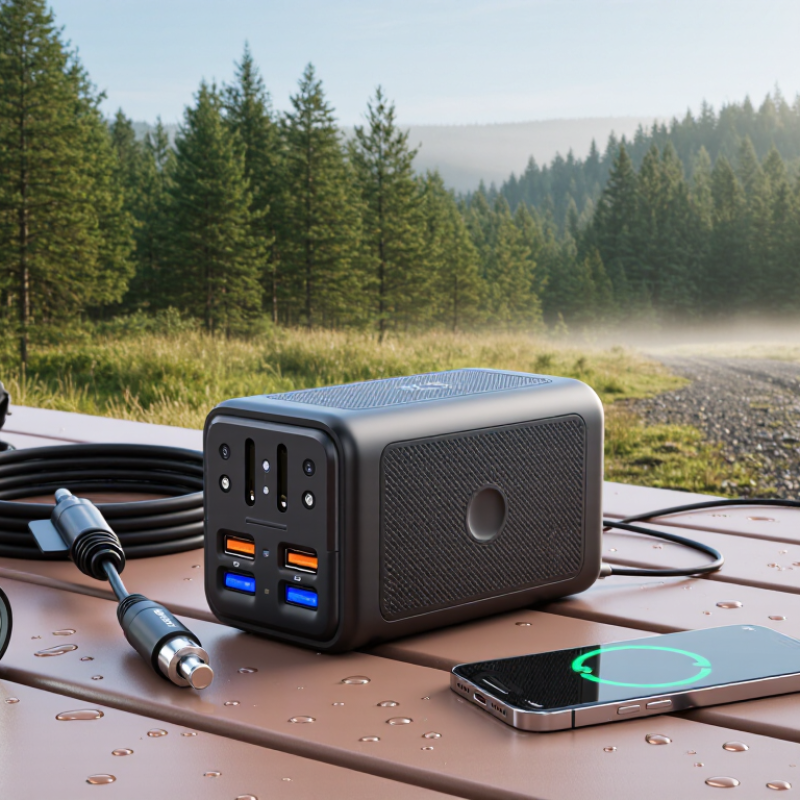
Understanding Portable Charger Types for Cars and Outdoor Activities
How to Choose a Portable Charger for Car and Outdoor Use?
Understanding Portable Charger Types for Cars and Outdoor Activities
Portable chargers fall into three practical groups: car adapters, power banks, and portable power stations. A car adapter draws energy from a 12-volt socket while driving. It suits phones, navigation devices, and small cameras. USB-IF states that USB Power Delivery 3.1 can support up to 240 watts, but your device determines the actual charging rate. More power is not always better.
Power banks store energy for hiking, emergencies, and roadside delays. Check watt-hours, not only milliamp-hours. A 20,000 mAh unit at 3.7 volts stores roughly 74 Wh before conversion losses. In cold weather, output can drop. Keep it inside a jacket pocket. That small habit matters. FAA guidance generally limits spare lithium-ion batteries to 100 Wh in carry-on baggage, so travelers should verify current rules before flying.
Portable power stations use larger battery packs and multiple outputs. They can run lights, laptops, or compact coolers at a campsite. Look for pure sine-wave AC output when powering sensitive electronics. Safety reports from the International Energy Agency continue to highlight battery quality, thermal management, and charging infrastructure as important reliability factors. Choose certified protection against overcharging, overheating, and short circuits. A common mistake is judging capacity alone. Cable quality, recharge time, weight, and weather resistance often matter more beside a muddy trail or an idling car.
Evaluating Battery Capacity, Power Output, and Charging Speed
A portable charger for car and outdoor use should match your actual devices, not just advertise a large capacity.
Capacity is usually listed in milliamp-hours, but watt-hours offer a clearer comparison. A 20,000 mAh unit may deliver less usable energy after voltage conversion and heat loss. In practice, expect roughly 70 to 85 percent of the stated capacity. Numbers can mislead. I once chose a large battery for a weekend trip, then found it awkward to carry and slow to recharge.
Power output matters when charging phones, tablets, cameras, or small laptops.
Check the charger’s watt rating and your device’s input requirement. A phone may need only 18 watts, while a laptop could require 45 watts or more. If several devices charge together, the available power may be divided between ports. That detail is easy to miss.
For car use, choose a unit that can handle repeated charging without becoming dangerously hot inside a parked vehicle.
Charging speed depends on both the charger and the cable.
A high-capacity battery may still recharge slowly if its input power is limited. Look for clearly stated input and output ratings, and use cables rated for the required current. Outdoor conditions also matter. Cold weather can reduce battery performance, while direct sunlight can raise internal temperatures. Keep the charger shaded and dry. My own planning is still imperfect; I often value maximum capacity over weight, then regret carrying it on a long trail. A balanced choice considers capacity, output, recharge time, size, and realistic use.
Checking Vehicle Compatibility, Device Support, and Charging Ports
A portable charger should match your vehicle before it meets your phone. Check whether your car has a 12-volt socket, USB-A port, or USB-C port. Read the vehicle manual for the socket’s maximum output. Never exceed that rating. A loose socket can interrupt charging on rough roads. I once assumed every car socket delivered the same power. That was wrong.
Device support matters just as much. List the devices you may carry, including phones, tablets, cameras, navigation units, and small lights. Check their required voltage, charging standard, and cable type. A charger with enough capacity may still charge slowly if its output is too low. USB-C can support higher power, while older USB-A ports often suit smaller devices. Check the cable, too. A damaged cable can create heat and unstable charging.
Ports should fit your real routine. Two ports may help passengers, but simultaneous charging can reduce output. Look for clear power labels beside each port. For outdoor use, choose a unit with a protected casing and covers over unused ports. Dust and moisture are easy to underestimate. Test the charger at home, then inside the parked vehicle. Note its actual charging speed, because advertised figures can feel optimistic. Keep some capacity unused; cold nights and repeated charging reduce performance. My own planning still misses one detail sometimes: cable length. A short cable can make a working charger frustrating.
How to Choose a Portable Charger for Car and Outdoor Use?
Checking vehicle compatibility, device support, and charging ports
The chart shows representative charging requirements for common devices. A portable charger should provide at least the recommended USB output, while its total capacity should be selected according to trip length and the number of devices. For vehicle use, confirm that the charger supports the vehicle’s 12V socket or USB port and that its input voltage matches the vehicle system. USB-C Power Delivery is generally the most flexible option for modern phones, tablets, cameras, handheld consoles, and lightweight laptops.
- Smartphone: USB-C or USB-A output, typically 5–25W.
- Tablet: USB-C output of about 20–30W for dependable charging.
- Camera: USB-C or USB-A output, commonly 5–15W depending on the battery system.
- Handheld console: USB-C Power Delivery, usually around 20–30W.
- Laptop: USB-C Power Delivery, commonly 45–100W; verify the laptop’s required wattage.
Comparing Portability, Durability, Safety, and Weather Resistance
How to Choose a Portable Charger for Car and Outdoor Use?
Portability matters when space is limited. I have found that a 10,000mAh charger usually balances weight and useful capacity. At 3.7 volts, it stores roughly 37 watt-hours before conversion losses. A larger model may support several devices, but it can become awkward in a small hiking pouch. Check output ratings carefully. Fast charging can reduce waiting time, yet compatible cables and devices remain necessary.
Durability depends on construction, not appearance. Look for reinforced corners, covered ports, strain relief, and a stated drop-test standard. IEC 60529 defines IP67 as dust-tight protection and temporary immersion up to one metre for 30 minutes. That rating is valuable near rain, mud, or a wet car floor. Still, water resistance is not waterproofing forever. Seals age, and repeated drops can create hidden damage.
Safety deserves more attention than capacity. FDNY recorded 268 lithium-ion battery fires in 2023, showing why damaged cells should never be ignored. Choose overcharge, overheat, short-circuit, and temperature protection. IATA’s 2025 passenger baggage provisions also treat spare lithium batteries as carry-on items, with batteries above 100 watt-hours requiring special attention. Do not leave a charger under a hot windshield. I once underestimated heat inside a parked vehicle. That was careless. Check the casing after charging, especially outdoors, because a swollen shell, sharp smell, or unusual heat signals a serious problem.
Choosing the Right Portable Charger for Your Budget and Usage Needs
How to Choose a Portable Charger for Car and Outdoor Use?
Choosing a portable charger begins with your actual routine, not its advertised capacity. For short drives and phone emergencies, a compact 10,000 mAh model may be enough. Longer camping trips need more energy, especially for phones, cameras, GPS devices, or small lights. Remember, usable power is lower than the printed number because energy is lost during conversion.
Your budget should match charging speed and durability. A basic charger costs less, but it may offer only one port and slower output. A mid-range option often provides USB-C fast charging, multiple ports, and clearer battery indicators. Higher-priced models may include weather resistance, stronger casing, or built-in lights. Those extras are useful outdoors, but not essential for every driver. I once paid for features I rarely used. That mistake changed how I compare products.
Tips: Check the charger’s output against your device requirements. Choose enough capacity for your longest typical trip, not an imaginary expedition. For car use, avoid storing lithium batteries in extreme heat, such as a closed vehicle under direct sunlight. Look for overheating, overcharging, and short-circuit protection. A textured surface also helps when your hands are wet or dusty. Before hiking, test every cable and charge the unit fully. Small details matter. Yet, no charger is truly convenient if it is too heavy for your bag or forgotten in a drawer.
How to Choose a Portable Charger for Car and Outdoor Use? - Choosing the Right Portable Charger for Your Budget and Usage Needs
| Usage Category |
Recommended Capacity |
Typical Output |
Vehicle Starting Capability |
Useful Ports |
Approx. Weight |
Typical Budget |
Best For |
| Basic roadside backup |
10,000–15,000 mAh |
5 V USB, up to 18 W |
Usually not available |
USB-A and USB-C |
0.2–0.35 kg |
US$15–35 |
Phones, cameras, GPS devices and short trips |
| Family travel charger |
20,000–27,000 mAh |
5–20 V USB-C, 30–65 W |
Usually not available |
USB-C, USB-A and sometimes wireless charging |
0.4–0.65 kg |
US$35–80 |
Multiple smartphones, tablets and handheld game devices |
| Laptop and camera field use |
25,000–40,000 mAh |
USB-C Power Delivery, 65–100 W |
Usually not available |
High-output USB-C and USB-A |
0.6–1.0 kg |
US$70–150 |
Laptops, drones, cameras and extended outdoor work |
| Emergency jump starter |
12,000–20,000 mAh |
USB charging plus 12 V jump-start output |
Approximately 300–1,000 peak A, depending on model |
USB-C, USB-A and clamp connection |
0.7–1.5 kg |
US$60–160 |
Starting compatible petrol and diesel vehicles during emergencies |
| Weekend campsite power bank |
150–300 Wh |
AC inverter up to 300 W; USB-C up to 100 W |
Not intended for engine starting |
AC outlet, USB-C, USB-A and 12 V socket |
2–4 kg |
US$150–350 |
Lights, small fans, phones, cameras and compact appliances |
| Extended off-grid use |
500–1,000 Wh |
AC inverter up to 600–1,000 W; USB-C up to 100 W |
Not intended for engine starting |
Multiple AC outlets, USB-C, USB-A and 12 V output |
5–10 kg |
US$350–900 |
Camping, vehicle-based travel, emergency backup and small tools |
Selection Checklist: Check the required output wattage, device compatibility, battery capacity, recharge time, weight, operating temperature, overload protection and airline restrictions before purchasing. A portable charger rated in mAh is commonly used for small power banks, while larger power stations are more clearly compared by watt-hours (Wh).
FAQS
Usable energy is often about 70 to 85 percent of the stated capacity. Voltage conversion and heat loss reduce the final amount. Numbers can mislead.
Not necessarily. A large battery may feel heavy during a long hike. I once chose maximum capacity and regretted carrying it.
Phones may need around 18 watts, while small laptops may require 45 watts or more. Check each device’s input requirement before buying.
They can, but available power may be divided between ports. Two passengers charging together may notice slower speeds. Check the power labels.
Recharge speed depends on the charger’s input limit and the cable’s current rating. High capacity does not guarantee fast recharging.
Check the vehicle manual for the socket’s maximum output. Never exceed that rating. Avoid leaving the unit in direct sunlight inside a parked vehicle.
Check for a 12-volt socket, USB-A port, or USB-C port. A loose socket may interrupt charging on rough roads. I once assumed all sockets had equal power.
Cold weather can reduce performance, while sunlight can raise internal temperatures. Keep the charger shaded and dry. Protect unused ports from dust and moisture.
Test it at home, then inside the parked vehicle. Measure real charging speed and check every cable. Advertised figures may feel optimistic.
Cable length can affect daily comfort. A short cable may reach a pocket but frustrate someone using a dashboard mount. My planning still misses this sometimes.
Conclusion
Choosing the right portable charger for car and outdoor use starts with understanding the available types, such as compact power banks, vehicle jump starters with charging functions, and multi-purpose battery stations. Consider the battery capacity, power output, and charging speed based on the devices you need to support, including phones, cameras, tablets, or emergency equipment. A higher capacity offers more charging cycles, while greater output and fast-charging support can reduce waiting time.
To decide how to choose a source charger for car and outdoor use, check whether it is compatible with your vehicle and devices, and make sure it provides suitable charging ports, such as USB or other required connections. Portability is important for travel, while a durable, weather-resistant design is valuable for camping, hiking, and road trips. Safety features such as overcharge, overheating, and short-circuit protection should also be considered. Finally, compare the charger’s price, performance, durability, and expected usage frequency to select an option that fits both your budget and practical needs.

 Caiku Electronic