Choosing a reliable charger begins with more than comparing prices, wattage, or attractive packaging. A charger may look professional while hiding weak components, unclear testing, or incomplete safety information. In real purchasing work, the small details matter. Check the label, model number, manufacturer address, and testing documents before placing an order. The charger should match the device’s voltage, current, connector, and charging protocol.
A practical question guides this process: What certifications are necessary for reliable source chargers? The answer depends on the destination market, charger design, and intended use. Recognized marks may include UL, ETL, CE, UKCA, FCC, or RoHS-related compliance, but each serves a different purpose. Some address electrical safety. Others concern electromagnetic interference or restricted substances. A trustworthy supplier should explain which standards apply and provide documents that match the exact model. Generic certificates are not enough.
Look closely.
Ask for test reports from accredited laboratories, not only supplier-created claims. Confirm the certificate number, issuing organization, product model, and validity period. Images of logos can be copied easily. That mistake is common. It is also worth checking production consistency, warranty terms, recall history, and independent customer feedback. No certification guarantees perfect performance, and this point deserves honest attention. Testing may reflect one sample, while mass production can vary. For stronger confidence, combine certification checks with sample testing, supplier audits, and clear after-sales support. Reliable sourcing is not a single search result. It is a careful process built on evidence, technical judgment, and a willingness to question convenient answers.
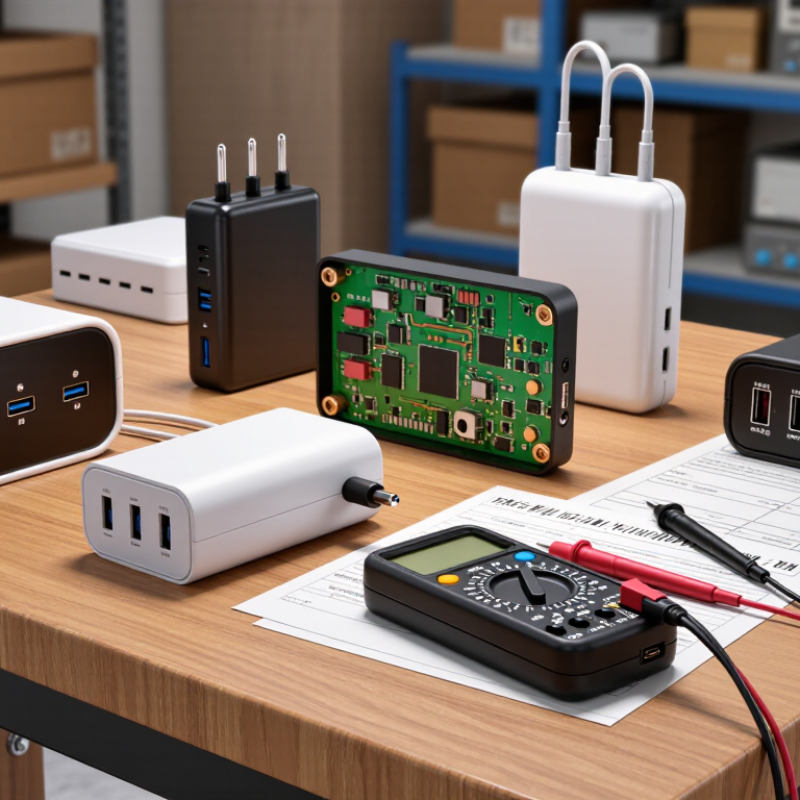
When checking a charger, look beyond attractive packaging and output numbers. IEC 62368-1 is a key safety standard for many modern power adapters. It addresses electric shock, fire, insulation, and abnormal operating conditions. A CB test certificate can support international acceptance when issued by a recognized certification body. However, the document must match the exact model.
CE marking indicates a manufacturer’s conformity declaration in the European market. It is not automatically proof of independent laboratory testing. UKCA serves a similar role for relevant products in the United Kingdom. RoHS addresses restricted substances, while electromagnetic compatibility testing evaluates unwanted interference. FCC compliance usually concerns emissions, not complete charger safety. These distinctions are easy to miss.
Check the certificate number, product model, rated input, output, and testing laboratory. The laboratory should have suitable accreditation and a clear testing scope. Compare the printed label with the supplied cable and plug. A 65-watt adapter should not become unusually hot during normal laptop charging. That detail matters.
Certification is not permanent protection. A factory may change components after testing. The certificate may cover only one configuration. This is where my own review would remain cautious. Ask for current reports, production-control evidence, and samples from the actual supply batch. A QR code alone proves little. Physical inspection, traceable paperwork, and sensible thermal testing provide stronger confidence.
A certification mark is only useful when it matches the exact charger model. Check the mark against the issuing organization’s public database. Search the certificate number, model code, manufacturer, output rating, and validity date. A printed logo alone proves very little. In a practical inspection, the model code on the charger should match the code on the certificate and packaging. Even one missing digit deserves a pause.
Request the complete certificate, not a cropped screenshot. Reliable documents normally show the applicable standard, test laboratory, electrical ratings, factory location, and certificate scope. Check whether the laboratory is accredited to ISO/IEC 17025. Also review the declaration of conformity, but do not treat it as independent proof. It is often supplied by the manufacturer. The European Commission’s Safety Gate report recorded electrical appliances and equipment among the leading notified product categories in 2023, showing why document checks matter.
Look closely at the physical mark. Uneven printing, incorrect spacing, blurred symbols, or a mark unrelated to the certificate are warning signs. Electrical Safety First reported that 98% of counterfeit chargers tested in one investigation failed basic safety checks. That figure is striking, although one investigation cannot represent every charger market. This is where buyers should remain skeptical. A genuine-looking document may still cover another model, another factory, or an outdated design. Keep a dated copy of every verification result and compare the charger’s input and output values with the certificate before purchase.
| Certification or Verification Item | Where It Commonly Applies | What It Indicates | Documents or Mark Details to Request | How to Verify It | Important Limitations |
|---|---|---|---|---|---|
| CE Marking | European Economic Area and other markets that accept CE-marked products | Indicates that the manufacturer declares conformity with applicable European Union requirements, which may include electrical safety, electromagnetic compatibility, and hazardous-substance restrictions. |
|
Check that the model number on the declaration, product label, and packaging is identical. Confirm that the declaration is signed and dated by the responsible manufacturer or authorized representative. | CE marking is generally a manufacturer declaration, not automatically proof of independent third-party certification. The mark alone does not prove performance, durability, or compatibility. |
| UKCA Marking | Great Britain, subject to current product regulations and applicable transition rules | Indicates conformity with applicable Great Britain product-safety and electromagnetic-compatibility requirements. |
|
Compare the UKCA mark, model identifier, rated input and output, and declaration details. Check whether third-party conformity assessment is required for the specific product category. | UKCA is not a universal quality mark. Requirements differ by product type, and a UKCA mark does not replace electrical safety or electromagnetic-compatibility evidence. |
| Recognized National Certification Mark | Countries or regions that require a local safety approval mark for mains-powered equipment | Shows that the charger has been assessed against applicable national electrical-safety requirements by an accepted certification route. |
|
Search the certificate number in the official certification database or contact the issuing authority. Confirm that the database entry covers the exact model rather than a similar family. | A valid mark may cover only specific models, factory locations, power ratings, or construction versions. A certificate for an adapter family may not cover every variant. |
| Nationally Recognized Testing Laboratory Certification | Markets that accept certification by an officially recognized independent testing laboratory | Indicates that an independent laboratory evaluated the product against a recognized electrical-safety standard and applicable national requirements. |
|
Use the laboratory’s official online directory or certificate-verification channel. Check the exact mark format, file number, model family, output rating, and manufacturing location. | Do not treat a laboratory test report as equivalent to a certification listing. Certification normally includes ongoing production controls, while a one-time report may not. |
| IEC 62368-1 Safety Evidence | Audio/video, information-technology, and communication-technology equipment, including many modern power adapters | Demonstrates evaluation against a hazard-based safety standard for electrical energy, fire, mechanical hazards, and related risks. |
|
Confirm that the document identifies the exact charger model and the correct standard edition. Review whether the document is a certification, a CB test report, or only an internal evaluation. | Compliance with a safety standard does not automatically confirm electromagnetic compatibility, radio compliance, energy efficiency, or USB charging interoperability. |
| CB Scheme Test Report and Certificate | International markets participating in the IECEE CB Scheme | Provides an internationally structured test result that can support national certification applications in participating countries. |
|
Verify the certificate and report numbers through the official CB certificate database or the issuing national certification body. Check all listed model variants and ratings. | A CB document is not automatically a license to sell in every country. Local deviations, national marks, registration, labeling, or energy requirements may still apply. |
| Electromagnetic Compatibility Evidence | Most regulated markets for electronic power supplies | Shows that conducted and radiated emissions, immunity, and other electromagnetic-compatibility requirements were evaluated where applicable. |
|
Check that the report covers the complete charger, not only an internal power module. Confirm the tested input voltage, output load, cable arrangement, and operating conditions. | Passing an EMC test does not establish electrical-safety compliance. Results may not apply after changes to the circuit, enclosure, components, firmware, or cable configuration. |
| Energy-Efficiency Compliance | Regions with mandatory external-power-supply efficiency and no-load limits | Indicates that the charger meets applicable average-active-efficiency and standby or no-load power requirements. |
|
Compare the test conditions with the product’s actual rated output and input-voltage range. Verify whether the requirement applies to the charger’s power class and intended market. | Energy efficiency is separate from safety certification. A charger may be efficient but still have inadequate insulation, thermal protection, or documentation. |
| RoHS or Hazardous-Substance Declaration | Markets that restrict specific hazardous substances in electrical and electronic equipment | Declares conformity with restrictions on substances such as lead, mercury, cadmium, hexavalent chromium, and certain flame retardants or plasticizers, depending on the applicable rules. |
|
Check the legal reference, product scope, date, responsible signatory, and whether the declaration covers the charger and its supplied cable or accessories. | RoHS addresses material composition, not electrical shock, fire, overvoltage, overheating, or charging performance. |
| Product Label and Rating-Plate Consistency | Every market and every mains-powered charger | Confirms that the physical product can be matched to its technical and certification records. |
|
Compare the label with the certificate, declaration, packaging, user manual, and purchase specification. Reject documents that refer only to a visually similar model. | Correct labeling alone does not prove that the product was tested or that production units remain identical to the tested sample. |
| Document Authenticity and Traceability | All certification and compliance documents | Shows that the evidence is current, complete, and connected to the exact product being purchased. |
|
Validate the document using the issuing organization’s official database or contact channel. Check for altered PDFs, inconsistent fonts, missing pages, mismatched addresses, and unexplained model substitutions. | A logo copied into a product listing or a generic PDF is not reliable evidence. Documents should be specific enough to identify the product and its certification scope. |
| USB Charging Performance Documentation | Chargers using USB Type-C, USB Power Delivery, or other standardized charging protocols | Helps confirm that the charger can deliver the advertised voltage and current profiles and can communicate safely with compatible equipment. |
|
Compare the advertised profiles with the product label and technical datasheet. Confirm that maximum power is available under the stated input, temperature, port, and cable conditions. | USB protocol documentation does not replace mains electrical-safety certification. A higher wattage claim does not by itself prove safe thermal operation or compatibility with every device. |
| Missing, Unverifiable, or Mismatched Evidence | Any market | Indicates a significant compliance and product-quality risk when required marks, certificates, or declarations cannot be authenticated. |
|
Pause the purchase until the supplier provides verifiable, model-specific evidence from an appropriate authority or independent testing organization. | Do not rely on price, packaging quality, customer reviews, or a single certification logo as a substitute for traceable compliance evidence. |
A reliable charger begins with a traceable manufacturer, not attractive packaging. Check the company’s legal name, factory address, support email, and product history. These details should match across the charger, manual, website, and test documents. A vague address is a warning sign. So is a seller who avoids technical questions.
Examine the exact model number, input rating, output rating, and manufacturing date. Then search the certification body’s official database, rather than trusting a printed logo. The listing should show the same model and manufacturer. It should also identify the tested standards and certificate status. An accredited laboratory or certification organization should explain its scope publicly. If the certificate belongs to a different model, the mark proves very little.
Keep the evidence. Save the certificate, product photos, and purchase record in one folder. This helps when a charger becomes unusually hot, makes noise, or charges slowly. Do not rely on one website review. Reviews describe use, but certification records address testing. I have found that small label differences are easy to miss, especially after long workdays. That is worth admitting. A careful check can still fail if the database is outdated. Contact the certification body directly when details conflict, and ask the manufacturer for a current declaration or test report. Reliable information should be specific, consistent, and independently verifiable.
A reliable charger must match your device’s input needs, not merely advertise a higher wattage. Check the device label, manual, or charging screen for voltage, current, and protocol requirements. For example, a 20 V, 3 A device needs up to 60 W. A 100 W charger may work, but only if it supports the device’s negotiated voltage profile.
USB Power Delivery matters here. The USB Implementers Forum’s USB Power Delivery Specification Revision 3.1 allows power levels up to 240 W, using up to 48 V and 5 A. However, the charger, device, and cable must support the same profile. A 5 A cable is essential for higher power. A thinner cable may reduce charging performance or create unnecessary heat. I once compared wattage alone and missed the protocol. That was a poor shortcut.
Look for output tables showing exact profiles, such as 5 V/3 A, 9 V/3 A, or 20 V/3 A. PPS support can improve compatibility with devices that adjust voltage dynamically. Safety certification still matters, but certification does not guarantee fast charging. The European Commission’s 2022 Common Charger Impact Assessment estimated annual savings of about 11,000 tonnes of electronic waste through charger standardization. That supports careful matching, not careless replacement. Independent test data should also report temperature, efficiency, voltage stability, and standby consumption. These details reveal weaknesses that packaging often hides.
How to Find Reliable Chargers with Required Certifications?
How to Identify Counterfeit or Misleading Certification Claims
A certification logo alone does not prove a charger is safe or compliant. During product checks, examine the exact model number, certificate ID, testing scope, and expiry date. These details should match the charger, packaging, and seller’s documentation. A genuine certificate usually appears in the issuing organization’s public database. Search manually instead of trusting a QR code. Fake pages can look surprisingly convincing.
Tips: Check the certification body independently. Compare its official website with the seller’s claims. Look for clear electrical ratings, testing standards, and authorized use of the mark. If the certificate covers only a cable, it should not be presented as approval for the entire charger. Ask for a complete test report when important details are missing.
Be careful with vague phrases such as “certified quality” or “international safety approved.” They may describe marketing, not an independent assessment. A certificate number with no searchable record is a warning sign. So is a logo printed unevenly or copied without required wording. Product photos can mislead, especially when the delivered item differs from the listing. I have found that small inconsistencies matter, although not every printing error proves fraud. My own inspection process is not perfect either; databases can be difficult to navigate, and certification scopes require patience. When evidence remains unclear, choose a charger with verifiable documentation rather than a cheaper promise.
The chart compares the published maximum power associated with major USB charging specifications. These figures describe protocol capabilities, not safety certification. A charger claiming USB Power Delivery should identify the supported specification and power profile clearly.
To check a certification claim, look for the exact model number, certificate or registration number, issuing organization, applicable safety standard, and a searchable record in the issuer’s official database. A logo alone is not proof of certification. USB-IF, IEC, and national conformity requirements are separate from one another, so one mark should not be presented as evidence of all certifications.
IEC 62368-1 addresses electric shock, fire, insulation, and abnormal operating conditions. It is a useful starting point, not complete proof.
Compare the certificate number, model code, input, output, laboratory, and validity date. Every detail should match the physical charger.
Not always. A conformity mark may reflect the manufacturer’s declaration, rather than testing by an independent laboratory.
No. It may cover one model, factory, component set, or configuration. A small design change can weaken the certificate’s relevance.
Search the issuing organization’s public database using the certificate number and model code. Keep a dated copy of your verification result.
Request the complete certificate, testing scope, electrical ratings, factory location, and declaration of conformity. Cropped screenshots are weak evidence.
An accredited laboratory should have suitable competence under ISO/IEC 17025. Still, the accreditation scope must match charger safety testing.
Watch for blurred symbols, uneven printing, missing digits, mismatched labels, or unusual heat during normal charging. One odd detail matters.
No. A QR code can lead nowhere, show outdated information, or reference another model. Paperwork needs physical confirmation.
Yes. A 65-watt adapter may become warm, but unusually high heat is concerning. I would pause and inspect it again.
Finding a reliable charger requires more than checking its appearance or advertised power. The key question is: “What certifications are necessary for reliable source chargers?” Look for safety and compliance certifications relevant to the charger’s intended market, such as marks showing that the product has passed electrical, thermal, insulation, and electromagnetic compatibility testing. Buyers should verify that certification marks are clearly printed, match the product documentation, and can be supported by genuine test reports or certificates. It is also important to check whether the manufacturer provides complete contact information and whether the certification body is independent and traceable.
Before purchasing, compare the charger’s voltage, current, connector type, charging protocol, and power rating with the requirements of your device. Be cautious of vague claims, unusual logos, spelling errors, missing model numbers, or documents that cannot be verified. Counterfeit chargers may imitate certification symbols without meeting safety standards. Careful comparison of specifications, documentation, manufacturer details, and certification records can help users choose dependable chargers and reduce the risk of overheating, poor performance, or device damage.
Caiku Electronic